


Julian Harber
Local writer and storyteller, George Murphy interviews local characters and personalities. More HebWeb interviews
Introduction
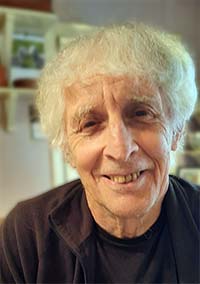
In the latest HebWeb Interview, George Murphy discovers remarkable events in the life of Julian Harber of Foster Clough, a naturalist, student rebel, historian, teacher, caterer, anti-nuclear activist and botanical expert.
His pioneering projects helped people to transform lives locally, nationally and much further afield.
Julian Harber answers
George Murphy's questions
Julian, Can you tell us about your formative years?
I was brought up in a somewhat unusual family in very conservative Eastbourne.
My father had joined the Communist Party in the late 1920s and had studied Russian at the London School of Economics. After graduating he visited the Soviet Union as an interpreter for a Canadian journalist. with the intention of settling there. Disillusioned, he returned home and became a Trotskyist (He was one of the British delegates to the founding conference of the Fourth International in Paris in 1938, the other being the West Indian writer C.L. R. James).
My mother was the daughter of Rosa Rosenburg born in Cable Street in the East End of London and an upwardly mobile man from a working class family in Warrington who rose to became a travelling representative for a firm making dentures. How they met is an unsolved mystery.
You've mentioned how your father and mother's love of nature has had an abiding influence on you
My father was interested in natural history from an early age. My mother excelled in botany at school and I think would have liked to have gone on to study it at university. However, her education at the prestigious fee-paying King Edward VI School in Birmingham was cut short by the sudden death of her father in 1934. There was no widow's pension from her father's firm and the family was forced to move to London and the support of Jewish relatives. Here, very unwillingly, my mother trained to be a secretary. There she joined the Labour League of Youth where she met my father. They married in September 1938.
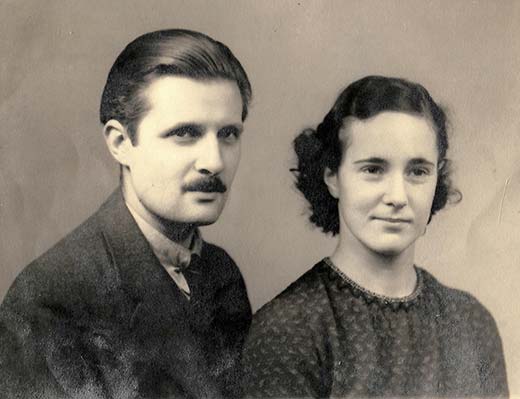
Julian's parents, probably at their wedding
My father was a life-long sufferer from of chronic asthma and in 1939 my parents moved from smoky London to the much healthier Eastbourne, my father having bought a Co-op Insurance round with a small legacy from his mother. It was a job he held for the rest of his life - an unusual choice for someone with his qualifications. Soon after their move my father took up ornithology.
Sometime around 1950, my parents gave up active politics and ornithology became my father's life. Somehow, he managed to cram his insurance round into half the week, devoting the rest of it to birdwatching including producing the Sussex Bird Report. He eventually became the secretary of the British Bird Rarities Committee.
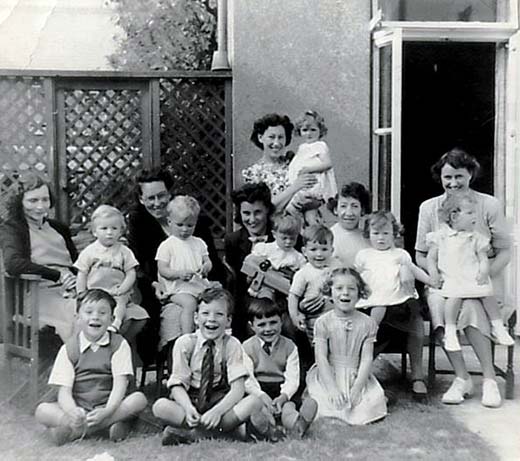
Photo: postwar baby boom.
Julian's mother is in the middle holding Julian with a toy lorry
My mother whilst still doing part-time secretarial work was able to renew her interest in botany. Family walks and holidays were extended natural history explorations - I can still remember looking for orchids on the South Downs and I have inherited my mother's love of flora as well as her books. I treasure her copy of Fitch and Smith's Illustrations of the British Flora with her carefully colouring in of some of the line drawings.
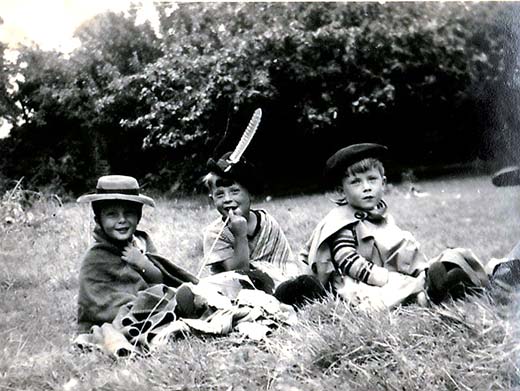
Julian (in the middle) with and his brothers
You did well at school. What were your favourite subjects?
I attended Eastbourne Grammar School. It suffered from the fact that in those days teachers were employed on the basis of their academic qualifications, not on any necessary ability as teachers. My favorite subject was history and happily my history teacher Mr. Harrison did know how to teach. That included how to write essays, something I found invaluable when I went to university
You passed your A levels and went to the new University of Essex
I wanted to study history at university, but in 1965 most universities required a qualification in Latin which I didn't have. So I went to the University of Essex and studied sociology, a subject I found largely ahistorical and uninteresting. My only teacher I really learnt from was Alasdair MacIntyre whose Social Philosophy course taught me how to think.
Essex University was a pretty wild place then with an exceptionally large number of left-wing students. In 1968, I was one of the organisers of the disruption of a meeting addressed by a Doctor Inch from Porton Down, an institute devoted to chemical and biological warfare – a particularly live subject when the US was spraying Agent Orange over Vietnam. The authorities reacted by suspending three students which provoked a complete university shutdown until they were reinstated. You can read all about it here.
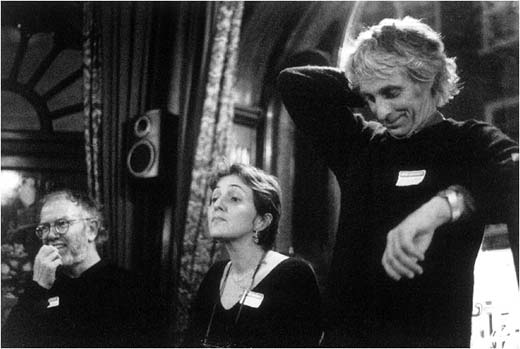
Reunion of the 1968 rebels, 30 years on.
Julian right, Chris Ratcliffe, HebWeb editor, to the left.
Via a girlfriend at Essex, I was introduced to the historians Edward (E.P.) and Dorothy Thompson and Edward subsequently encouraged me to apply for an MA at the newly established Centre for the Social History at Warwick University which he headed. He was a brilliant and inspiring teacher. Whilst there, I was involved in another campus rebellion. Provoked, in this case, after we broke into the Registry and found the university had been keeping files on the political activities of left-wing students and staff.
When did you arrive in Calderdale?
Most winters my father had supplemented the family income by part-time lecturing for the Workers' Educational Association (WEA) and after Warwick, having moved to London, I followed in his footsteps. In 1975, when I eventually needed a full-time job, I successfully applied for the post of WEA Tutor/ Organiser for the newly created local authority of Calderdale. The Thompsons had lived in Siddal in Halifax from the late 1940s to the early 60s and Edward was my main referee.
Much of my initial teaching was on courses for shop-stewards and safety reps designed by an exceptionally talented team based in the TUC's HQ in London. Their innovative approach to teaching and learning was something I subsequently applied when teaching school governors for the Local Authority and for a national WEA course Helping in Schools for voluntary helpers in primary schools (about which more later). Key features included "Discovery Exercises" where students sought information from their workplaces on such matters as disciplinary and grievance procedures, followed in class by small group discussions where students compared their findings with others from different workplaces.
The courses for the TUC also gave me a way into the local trade union movement and one of the off-shoots of this was a project backed by Alan Betteridge of the Calderdale archives to collect in local labour movement records. And just in time, as the traditional industrial base of the area was in the process of disappearing. Without this project, most of what I collected including the records of the Northern Carpet Union based in Dean Clough, Halifax and the once powerful Todmorden Weavers Association, would have probably gone to the tip.
How did you first meet the feminist historian and author, Jill Liddington?
It was through this project that I came to meet Jill then living the other side of the Pennines in Rossendale. Various mutual friends including Sheila Rowbotham, knowing we were both single had tried in vain to match-make, which both of us being obstinate we ignored. But then, when I was invited to give a paper on my archive project at a History Workshop conference at Ruskin College, Oxford it turned out Jill was billed to give a paper in the same session. The rest as they say was history.
In the WEA, I became active in the Workers' Education section of Association of Scientific, Technical and Managerial Staffs (later, Manufacturing, Science and Finance, even later UNITE) eventually becoming its national chair. In 2003, when the WEA was in danger of becoming bankrupt due to gross financial mismanagement, I wrote a paper on behalf of the union entitled The Origins of the Present Crisis which contributed to the accelerated retirement of the WEA's General Secretary and Assistant General Secretary.
When did you become involved with CND?
As historians have noted, anti-war and peace movements arise when large numbers of people are fearful of what is happening, but hopeful something can be done about it. The 1979 NATO decision to deploy US nuclear armed cruise missiles in Europe was such a moment. And like many people I was inspired by Edward Thompson's pamphlet Protest and Survive! In the 1980s, I became active locally, nationally and internationally. I was on CND's International Committee and for a time the chair of British European Disarmament (END).
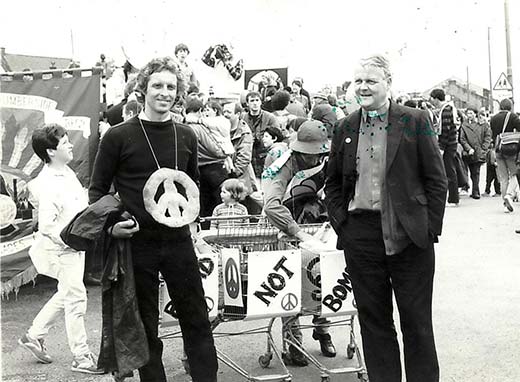
Julian with Bruce Kent at the Bread not Bombs demo, Bradford, 1984
This involved a whirlwind of activity. But two memories stand out.
One was on behalf of END attending the huge 21st Marathon Peace March in Greece in 1984 as the guest of the Greek Committee for International Detente and Peace (EEDYE). Starting out a little after dawn, we marched the whole 25 miles to Athens.
On the way, I was introduced to the legendary Manolis Glezos, famous for tearing down the Nazi flag from the Acropolis in 1941 during the German occupation. As we entered the working class suburbs of Athens, people applauded him from their balconies and came out from their doorways to shake his hand.
In Athens the march ended in Syntagma Square, where I was told I was to be one of the speakers - I don't know how many thousands of people were there. The interpreter said "make it short" so I did, paying tribute to Gregoris Lambrakis, the pacifist MP who in 1963 had been on CND's Aldermaston March and who days later walked alone on the first Marathon Peace March (it had been banned, but as an MP he had parliamentary immunity). Weeks after his walk he was assassinated. Half a million people attended his funeral.
The second was attending as a CND delegate to a conference organized by the Soviet Peace Committee (a state-sponsored organization) in Moscow in 1987. Gorbachev had become the leader of the Soviet Union in 1985 and already under the watchwords of Glasnost and Perestroika the disintegration of the authoritarian state was visibly beginning to happen.
When one of our delegates went to a one-to-one meeting with a couple of Russian "Generals for Peace", she was astounded when half way through the interview, the female official interpreter provided said something along the lines of "Why do you want to listen to these old bores? They have nothing interesting to say". Later, to our amazement, someone from the much-hounded Moscow Independent Peace Movement, which we had visited the previous day in a shabby outlying suburb, was allowed into the Conference. Four years later the Soviet Union was dissolved and the Soviet Peace Committee disappeared.
Can you tell us about your enjoyment of camping and the Hebden Bridge Woodcraft Folk?
Forest School Camps (FSC) is a radical camping charity established in 1947. I was part of a group who in 1974 (with FSC's blessing) seceded to form Flysheet Camps with a mission of providing adventurous outdoor experiences for children from low-income families who rarely had holidays. Camp fees for children were mainly paid for by local authorities or from grants from various charities. FSC staff are paid, but we paid for ourselves.
Mostly in our twenties and none of us with children, we took up to 50 children to often remote places for ten days or fortnight. There were never any serious incidents and in retrospect I think what we achieved was pretty remarkable. I have an abiding memory of a girl from inner city Liverpool on a camp in Northumberland happily frying slices of a giant puffball, flavoured with wild thyme, both of which she had gathered from a local field.
Every camp needs a caterer and here I found my forte, working out menus and visiting Cash and Carries to buy provisions. At first, I used to lay awake in my tent worrying whether there was the right amount and type of food for the following day, but after a couple of years I just had a routine worked out. Caterer, not cook. The philosophy of the camps (inherited from Forest School Camps) was that groups of children and adults took it in turns to cook. My main role was providing the menus and giving advice – but available to step in when things went awry.
In 1994 I transferred my commitment to radical youth organisations to the Hebden Bridge Woodcraft Folk with its dedication to peace and its motto "Span the World with Friendship". There, in the Elfin Group, I made friends with a talented group of adults and their lively children.
There were lots of innovative activities including weaving workshops from a guest visitor, the acclaimed local textile artist Sue Lawty. I was the caterer on a succession of camps in Colden. A story about the philosophy of the Woodcraft Folk, when students walked out of Calder High School in March 2003 in protest against the Iraq War and sat on the front lawn I was told it was two ex-Woodcraft pupils who made sure the protesters picked up any rubbish as the demonstration ended.
Alas, the local group is no more. Lots of parents would love their children to join, but for whatever reason do not want to volunteer to help themselves. It is a general problem faced by other youth organisations with many having waiting lists.
What was your role in developing School Governor Training and Helping in Schools?
In 1984, when the Yorkshire North District of the Workers Education Association was suffering from one of its perennial financial crises, I was seconded to work for Calderdale Local Authority for one day a week to develop their School Governor Training Programme – a secondment that lasted until my retirement in 2006!
As I noted earlier in this interview, the courses I developed drew on my experience of teaching shop stewards and safety reps. The discovery exercises included governors finding out about the constitution of their governing bodies, and their role in staff appointments. And of course, small group discussions where governors compared their findings, hopefully leading to the promotion of best practice. As such, they were in direct contrast to the top-down didactic courses taught in many other local authorities.
Believing that the only way to teach school governors about their role was to become one myself I became a governor at Siddal Infants School in Halifax, just across the valley from Bankhouse Lane in Salterhebble, where Jill and I were living. Not being familiar with primary schools since leaving one in 1958, I decided to familiarise myself by becoming a voluntary helper in the school.
Finding that parents volunteering to help in primary schools was quite common but those that did so were often unsure of what constituted effective volunteering, I decided to develop a course to meet the need.
Called Helping in Schools, (and often known simply as HIS) I taught the first course in Sowerby Bridge in 1997. It was a free, one whole day a week ten-week course accredited by the National Open College Network. This again involved discovery exercises, small group discussions, but in addition a minimum number of hours volunteering in a school; all to be recorded in a portfolio of work. It was a deliberately demanding course, based on the premise that once enthused students could be motivated to work hard.
True to WEA philosophy, the key target group were adults who had left school with few or no qualifications and unsurprisingly most who enrolled were women whose children were now at school and wanted something to do and hopefully better their and their children's lives.
Initially, it ran just in Calderdale, later expanding to Kirklees, then to other Yorkshire LEAs, then across England. The team of part-time tutors in Calderdale included Jo Hallgarth and Caroline Duke recruited from the Woodcraft Elfin Group as well as Hebden Bridge resident, the late Julie Cockburn (for whom see Lives Remembered here on Hebweb).
In the early days when I had the time, I visited courses that were held in local schools and led a session with parents and children where we played parachute games and did circle dancing; both activities I had leant in Woodcraft. It made an interesting change from alerting school governors to the difference between "should" and "must" in school regulations.
My records show in the academic year 2001-2002, Helping in Schools recruited over 6000 students across 47 different LEAs. This resulted in my becoming the national organiser of the project.
In order to attract funding, we conducted an annual survey of students from the previous year's enrolments. With a high response rate, in 2002 this showed that some 43% of students had obtained jobs in education, mainly as classroom or special needs assistants. Many had progressed on to further courses including NVQs, and GCEs. These statistics were used in evidence to apply for funding from local authorities, various other local sources and most importantly what proved to be a short- lived Family Learning Fund administered by a government quango. Over a three-year period this fund alone granted the WEA over £900,000.
In the end the whole project was killed off by government bureaucracy. Funding became available only for recognized qualifications and our Open College accreditation was deemed ineligible because Helping in School was solely a WEA course. Both from the annual surveys and from anecdotal evidence, it is clear that some of the thousands of ex HIS students eventually became teachers and I like to think that somewhere out there there might be head and deputy headteachers who started out on a HIS course.
You ran a very successful course for retired people?
Another earlier spinoff from becoming a governor in Siddal was a course for retired people in the area. I got the idea and title from Jill who had pioneered a similar course in Queensbury. Promoted by Age Concern and running over five terms from 1988 to 1989, it attracted some 60 people who had been bought up in what they always referred to as "the village".
All had left school at the minimum age of 14. Secondary education had to be paid for, something most Siddal parents couldn't afford. There was one exception – an orphan whose fees to attend Elland Grammar School were paid for by the Halifax Board of Guardians. It is unlikely that Guardians in rural areas of Yorkshire would have been so enlightened. He then went on to become a teacher. Living in Southend, he came every five weeks or so to attend the class.
 In some weeks, the students were given a topic related to their childhood e.g. weekly routines, school life, and were encouraged to write about it outside the class. I would collect in their contributions the following week and write up extracts for the week after that, leading to further discussions. It led to a 50-page pamphlet recording what is now a lost world - outside toilets, lamplighters, the weekly bake, Whitsunside sings and parades. The booklet contained some of the many photographs bought into the class, some coming from as far away as America.
"Everything is related to everything else" as Lenin once said. During one of the sessions, I read out an appendix to Edward Thompson's article on Rough Music in his Customs in Common. This was an account written in the early 1960s by a former Siddal resident Hanson Halstead of a rough musicing in Jubilee Road. Sometime before the First World War, a married women, and another man she had moved in with, were both drummed out of the village. Effigies of both were paraded around the area accompanied by the beating of baking trays and the like and then set alight in front of their house. "Ah the burning of Mrs Hewitt, I was there," exclaimed Mr Womersley, who born in 1901 and was the oldest man in the class. Without his evidence, the name of the women who had so offended local mores would have been lost to history.
You moved to Foster Clough, on Heights Road, where you have a large back garden. Can you explain for us how you developed your specialist knowledge of the species of a particular shrub?
In 1993, Jill and I moved to Foster Clough and this, for the first time, gave me an opportunity to create an extensive garden. But gardening at almost 900ft is a challenge and there was a need to protect it with a windbreak. The back garden has a 200 yard fence along a field used for animal grazing, so shrubs that wouldn't be eaten were needed. The thorny Berberis seemed to be the answer. Rather than rely on common garden centre plants, I soon decided to go for different species, a decision that led after my retirement to devoting much of my time to the genus.
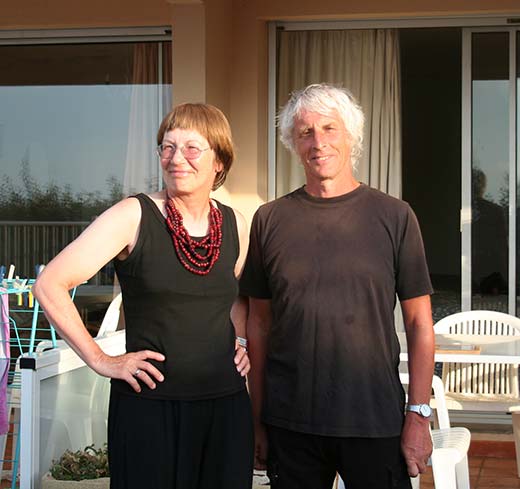
Jill and Julian, Corsica 2006
Without any prior qualifications I had to teach myself botany from scratch. It has involved me visiting herbaria in the UK, Europe, the US and China as well as two long collecting expeditions in mainland China and a short one in Taiwan. The long ones took me to parts of China including Qinghai where foreigners rarely visit. Some of this was funded by the National Geographical Association and the Royal Horticultural Society.
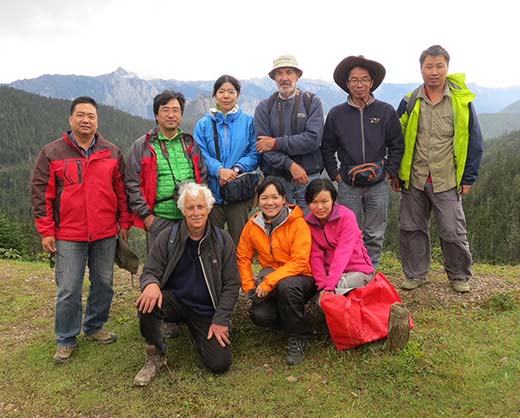
Meeting up with Japanese and Chinese botanists Yunnan 2013.
Dave Boufford on middle of back row
In Taiwan in 2014 I joined members of the Taiwan National University Hiking Club on an expedition to the remote Guanmen Shan to look for two Berberis species that had not been seen since they were collected by the Japanese ethnographer Mori Ushinosuke in 1910.
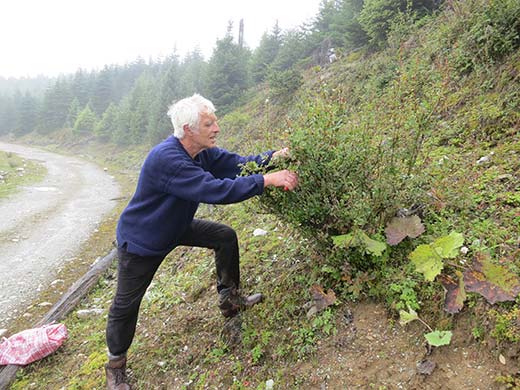
Collecting Berberis specimens Yunnan, 2013
In preparation for the expedition, I spent weeks practicing on the steepest slope I could find nearest to Foster Clough (the aptly named 100 steps) and then climbed Snowdon with a full pack. Led by Taiwanese Berberis expert, and now firm friend Chih-Chieh Yu, we made our way along a degraded logging trail and then upward through a leech-infested, warm, temperate rain forest to a Qing dynasty ridge path. We carried everything we needed including a plastic tarpaulin which slung between trees provided our sleeping accommodation. We found both the species we were looking for as well a completely new one which Chih Chieh and I eventually published as Berberis morii.
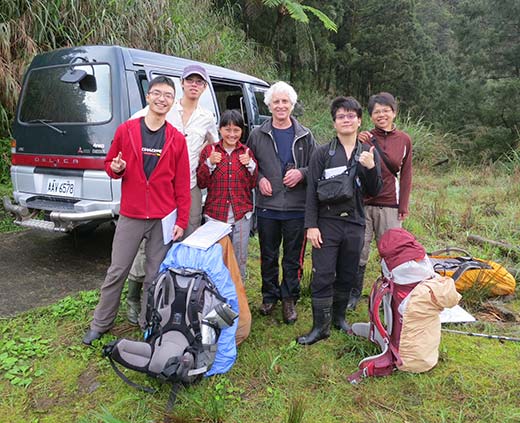
Collecting in Taiwan, Chih Chieh Yu, second from right
 In 2020, my Berberis of China and Vietnam a Revision was published which included a further 71 new species. But the pandemic cancelled what was to be my last collecting expedition to China.
I enjoy the challenge of naming new species. Rules are laid down, but within this framework the person authoring a species has a free choice when it comes to naming (no one ever calls a species after themselves!) My favourite new names are a Tibetan species Berberis pluvisylvatica from the Latin for rainforest and Berberis gyaitangensis after the ancient Tibetan name for the Zhongdian Plateau in Yunnan. Another species I published is Berberis boufordii named after David Boufford, an American who was on both China expeditions and who taught me how to gather, preserve and record the best specimens in the field and much else.
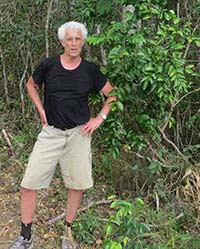 In 2016, Jill and I celebrated our 70th year by having a holiday in Cuba. There, I couldn't resist seeking out the island's only Mahonia – a genus closely related to Berberis – in a nature reserve not far from where we were staying. Accompanied by a lovely guide, it took all day and we had more or less given up before we found it. It turned out it had been misidentified as being the same as a species found in Mexico. In 2023, it was published as a new species Mahonia sagrana with a Cuban botanist as co-author
My collecting days are now over, but I am currently an unofficial mentor to an Indian PhD student whose subject is the Berberis of Arunachal Pradesh in NE India. He is an excellent researcher and an intrepid hiker in terrain where vehicular access is impossible. Together we have so far published three articles with more to follow.
Tell us about your tastes in music
I was brought up in a strictly classical music household. As was my mother, who in the 1930s introduced my then philistine father to the classics by taking him to free lunchtime concerts in London.
My mother however, believed that the last proper classical composer was Brahms – though an exception was made for Rachmaninoff's 2nd Piano Concerto. But listening to the car radio when driving around as part of my WEA job I kept coming across unfamiliar pieces I really liked. Eventually I discovered the composer was Mahler whose symphonies I now know virtually by heart, my favourites being his 6th and 7th. In this way, I also discovered Elgar and Shostakovich.
Have you a final memory you would like to share?
In 1838 Ann Lister of Shibden Hall was the first women to climb Vignemale, the highest peak in the French Pyrenees. In July 2003 Jill, her sister Annie and and I climbed it led by Annie's partner Tim Atkinson, an expert mountaineer. We carried ropes, ice axes and crampons and spent a night high up in a mountain hut. The next day's final ascent involved crossing a glacier, carefully avoiding the deep crevices. We then hurried down as the weather started to break. A memorable expedition.
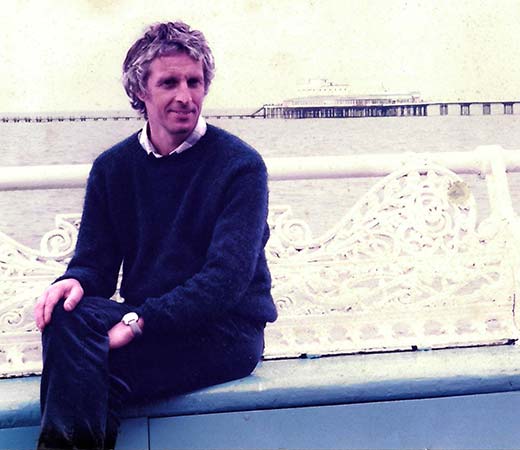
Photo: Blackpool, early 2000s
More HebWeb interviews from George Murphy
If you would like to send a message about this interview or suggest ideas for further interviews, please email George Murphy