


Sixth series, episode 2
All six series are available here on the HebWeb.
In this episode, George Murphy jokingly recalls misunderstanding a local phrase when he arrived in Calderdale. He gives a personal account of recent floods and welcomes the huge investment in the flood resilience scheme. He admits to reading up on the Stefan Kiszko trial over fifty years and welcomes the publication of a Todmorden solicitor's inside story of the case. He ends by praising the survival of a local institution.
What's going on?
It's hard to welcome the meteorological start of spring, despite the collared doves and the nattering magpies setting up homes in the trees nearby and the green shoots of daffs and the UK economy emerging, when bombs are cascading on cities in the Middle East and the war in Ukraine continues.
I'm still getting my head around green issues not being mentioned in a by-election won by the Greens. Polanski instead took up the George Galloway tactics of appealing to one part of the local community on his path to victory.
An offcumden arrives in West Yorkshire
When I moved to Halifax in the 70s, it quickened my pulse to hear lasses say,
"See you later …"
(inspired by Robb Wilton)
I was leaving a Halifax cafe one day,
When a waitress said, "See you later!"
Well, being a recent offcumden,
I thought that she'd asked me to date her.
But when I nipped back before closing time,
"We've stopped serving," the manager said.
I said, "I've come to pick up your waitress."
He said, "My fiancé? I'll punch your head!"
I said, "Whose?"
He said, "Thine!"
I said, "Mine?"
He said, "Yes!"
I said "Oh?"
He said, "Do you want a fight?"
I said, "Who?"
He said, "Thee!"
I said, "Me?"
He said, "Yes!"
I said, "No!"
When the waitress came over,
I said, "Haven't we got a date?
Will you kindly tell him it's so!"
She said, "I'd rather stick forks in my head."
So then I took that as a No!
Flood Money
The Council has agreed to the plans for flood resilience work, a project that will last from 2027 to 2030. The government will fund the reconstructions with £81 million pounds.
We live in a steep sided valley, but fortunately, the peat bogs on the moors above us help to store and slow precipitation, unless the peatbogs continue to be damaged by landowners.
I became aware of the degradation of peatbogs, when I read an article by George Monbiot in The Guardian on 7th June 2012, about the despoliation of Walshaw Moor.
On 16th June 2012, I wrote a letter to the HebWeb Forum:
"Monbiot writes about a grouse estate owned by a retail tycoon where staff have been burning off blanket bog. These are habitats of special scientific interest in the Pennines, but some landowners have been burning them off to improve grouse shooting. This makes the habitat less suitable for other species. The bog lies on top of peat and according to the Commission of Inquiry on UK Peatlands this causes massive escapes of CO2 equivalents into the atmosphere."
Monbiot was angry that Natural England had backed off a legal challenge to the landowner.
A few days later, on the evening of June 22nd, the first and heaviest of the three floods that year swamped our gardens and almost reached the raised decking in front of the houses. Vicky from one of the Lock Keepers cottages came round and told us to move our cars to safety. We sent our son upstairs to reassure him. As dusk fell, I joined Amanda, another neighbour, in rousing narrow boat owners who parked in our cul-de-sac, telling them to move their cars.
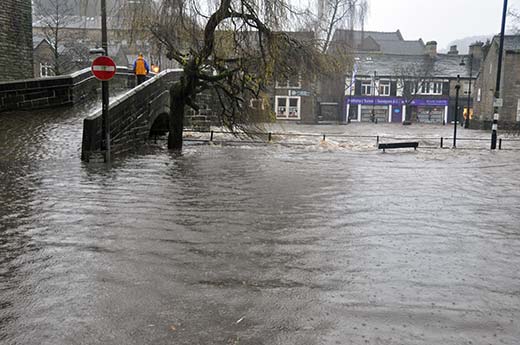
Photo: HebWeb, Boxing Day 2015
The 2015 Boxing Day flood occurred just as Christmas Day ticked past midnight. We had our close family with us, and because of the hubbub of party games and chatter, we were fortunate that Beryl from a few doors away banged on our door to tell us the siren was blaring a flood warning. Good neighbourliness broke out up and down the valley.
Amanda and Debbie, returning from family in Carlisle, heard reports of the flood on their car radio as they drove down the M6. They managed to reach Station Road and driving down the lane towards the masons yard, Debbie braked hard, just in time to avoid a chasm in the unmade, unadoptedlane caused by a broken in overspill pipe.
Thousands of properties were flooded in Calder Valley, costing an estimated £150 million of damage. Living between the canal and the river, many properties in the floodplain were deemed unfit for human habitation. Some would need to be demolished. In Hebden Bridge, properties beyond George's Square were still illuminated by street lights. The rest of the town was a blackout, recalling wartime conditions.
When our daughter drove back to her home in Mytholmroyd, she was redirected over Heights Road. Properties in the centre of town, including the primary school, were filling with contaminated water.
In the immediate aftermath of the flood, Halifax Labour MP Holly Lynch approached her Conservative, Calder Valley counterpart Craig Whitaker and asked him to bang on the doors of Cabinet Ministers to secure funding for a flood resilience scheme. Shopkeepers, businesses and homeowners were given financial compensation and we got financial support to make our cellar more flood proof.
Mytholmroyd was one of the first towns in need of a makeover. For four years, drivers on Burnley road had to show their own resilience, as stop go signs and temporary lights were set up and diggers, massive cranes and trucks were parked up on the main road.
Soon it will be Hebden Bridge's turn to get top of the range protection. It's been annoying to read complaints about the proposals from some shop owners who benefitted from flood grants after 2015, about the disruption caused by the resilience scheme. Some, who obviously didn't experience the power and immensity of the floods have suggested that if the street grids were cleared properly we wouldn't need the resilience scheme.
The Kiszko trial
Having read about this miscarriage of justice in documentaries, in contemporaneous news reports and in learned legal articles, over the last fifty years, it's still heartbreaking to read the detailed inside account of the tragic events in the recently published Good Fortune: Recollections of a grateful lawyer, by Campbell Malone (available from Amazon).
The Todmorden solicitor was described by the Criminal Cases Review Commission, before his retirement, as 'the pre-eminent appellate lawyer of his generation.' He gives blow by blow accounts of his key role in famous cases, including the Shrewsbury Building Workers trials and The Court of Appeal case involving Shaken Baby Syndrome. The whole book is inspirational, but, for HebWeb readers, I'll focus on the murder case that was nearest to home.
We moved to Calderdale in 1974, and our first child was born during the hot summer of 1976, on the palindromic date of 6/7/76, the day before the trial that led to Stefan Kiszko's wrongful conviction for the murder of Lesley Molseed. Due perhaps to the coincidence in dates, as I read about the scandal of Stefan's 17 year imprisonment, I found myself thinking back to holidays and special occasions in our daughter's life as she grew towards adulthood and about Lesley, and her lost years.
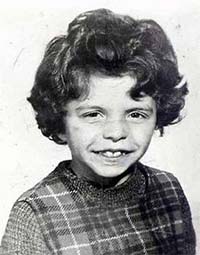 Lesley Molseed (pictured right) was born with a congenital heart condition and cardiac complications. She was undersized and frail with a reduced mental capacity for her age. Shortly before 1 pm on Sunday, 5th October 1975, she ran an errand to a local shop, but never returned home. Three days later, her body was discovered on the Moors above a layby on Rishworth Moor. She had been stabbed 12 times and there was seminal staining on her knickers and on her skirt. Leslie had been killed where her body had been found and the killer had masturbated over her body.
We lived a few miles from the site of the murder. I grew up in Ellesmere Port and the father of one of my friends was on the jury at the Moors Murder trials. So, although I loved the local moors, I've never mentally thrown off their association with child murders.
Charlotte Kiszko
Hebden Bridge's John Pickering, was a leading industrial disease specialist. I confess, John and Campbell are two of my local heroes, and I was fortunate enough to interview John about the Acre Mill disaster.
John had helped Stefan's mum Charlotte, in her claim for compensation for byssinosis, caused by working in the cotton mills of Rochdale. He referred her case to his friend, Campbell Malone. Campbell recalls, "John felt it needed the criminal experience he lacked and he kindly suggested that she approach me. It was very much down to Charlotte's passion and insistence I started to look into the case … I cannot pretend that I was immediately convinced of (Stefan's) innocence but the more time I spent on it the more I felt there was something wrong."
Charlotte always insisted that Stefan had been visiting his father's grave with her and her sister Alfrida at the time that Lesley was abducted.'
The Police investigation
Stefan Kiszko had come to the attention of the murder investigation team when four girls: Maxine Buckley (aged 12), Catherine Burke (16), Debbie Brown (13), and Pamela Hind (18), claimed that Stefan had exposed himself to them the day before the murder. Police formed the view that Kiszko was the likely killer, although he had never been in trouble with the law and had no social life beyond his mother and aunt – and he certainly did not expose himself to children.
Having watched many police dramas over the years, I was surprised to discover from Campbell's book that prior to the Criminal Evidence Act of 1984, suspects did not have the right to have a solicitor present during interviews!
The police did not ask Stefan if he wanted one.
His request to have his mother present while he was being questioned was refused.
Crucially, the police did not caution him.
After admitting the murder to police, Stefan was charged with Lesley's murder on Christmas Eve 1975. A psychological evaluation showed that Stefan had a mental and emotional age of just twelve years. He had an unusual hobby of writing down registration numbers of cars that annoyed him, which supported police suspicions. Investigators then pursued evidence which might incriminate him, and ignored other leads that might have taken them in other directions. At the trial, prosecutors tried to pick holes in the alibis provided by Charlotte, Stefan and his aunty 'Frida.'
The trial began on 7th July 1976 under Mr Justice Park at Leeds Crown Court. He was defended by David Washington QC who later became Home Secretary. The prosecuting QC Peter Taylor became Lord Chief Justice the day after Stefan was cleared of the murder in 1992.
In court, Stefan said that he had never met Lesley and therefore could not have murdered her. He claimed he was tending to his father's grave with his aunt at the time of the murder before visiting a garden centre and then going home. When asked why he had confessed, he replied, "I started to tell these lies and they seemed to please them and the pressure was off as far as I was concerned … the police would check out what I had said was untrue and then let me go."
In his book, Campbell Malone explains that during the trial, the defence team took the unusual step of not only putting Stefan's alibi and denial to the jury, but also an alternative defence, relying on the expert evidence they had called, to bring in a verdict of diminished responsibility and asked the jury to convict on manslaughter if they rejected Stefan's evidence.'
In courtroom parlance this is known as a 'two horses' defence.
Unsurprisingly, with his defence team acting as if they didn't believe their client's case, Stefan's conviction for murder was secured by a 10-2 majority verdict. He was given a life sentence.
Stefan in prison
After his imprisonment, Stefan was physically attacked by inmates on four occasions. As well as his physical injuries, from late 1979 onwards he showed signs of mental deterioration. In April each year, he was informed that eligibility for parole required an admission of guilt. If he continued to deny murdering Leslie he would spend the rest of his life behind bars.
In February 1991, with the help of a private detective named Peter Jackson, Campbell Malone finally convinced the Home Office to reopen the case, which was then referred back to West Yorkshire Police.
Detective Superintendent Trevor Wilkinson was assigned to the job and immediately found glaring errors in the police procedures used in 1976. Not least, witnesses who had not been called at the original trial testified that they saw Stefan, Charlotte and Frida at the cemetery and at a nearby shop on the day Lesley was murdered.
Judicial Investigation
Ten months before his parole hearing was due, on 17 February 1992, the judicial investigation into Kiszko's conviction began. It was heard by three judges. After hearing the new evidence presented by Stephen Sedley QC for the defence who said the original verdict "could not in all probability have been obtained if new medical evidence had been before the court at the time of the trial." The prosecution lawyers, did not put up any contrary argument and immediately accepted its validity.
After hearing the new evidence, Lord Lane said, "It has been shown that this man cannot produce sperm. This man cannot have been the person responsible for ejaculating over the girl's knickers and skirt, and consequently cannot have been the murderer."
Stefan Kiszko was cleared, and Lord Lane ordered his immediate release from custody.
In fact, his innocence could have been demonstrated at the trial. The pathologist who examined the victim's clothes found traces of sperm, whereas the sample taken from Stefan by the police contained no sperm. Medical evidence that Stefan broke his ankle some months before the murder and being overweight he would have found it difficult to scale the slope to the murder spot were suppressed by the police and never disclosed to the judge or the jury.
The 1976 trial judge Sir Hugh Park, who had praised the police and the girls at the original trial for bringing Kiszko to justice, apologised for what had happened to Stefan but said he was not sorry for how he had handled the court case.
Neither Lord Park, the four girls, and the prosecution barrister Peter Taylor offered any apology, nor did any of them express any words of remorse or even simple regret for what had happened. Even the West Yorkshire Police, while accepting and admitting they had been wrong, tried to justify the position they had taken in 1975. Waddington said that if the evidence had been available in July 1976, the trial would have taken 'a very different course'.
Anthony Beumont-Clark MP, said, "This must be the worst miscarriage of justice of all time. It brings shame on everyone involved in the case."
Stefan Kiszko died at 1:00 a.m. on 23 December that year, after a heart attack at his home, eighteen years and two days after he made the confession that helped lead to his wrongful conviction for murder. Four months after her son's death, Charlotte Kiszko died at Birch Hill Hospital, Rochdale.
After being released from prison, Stefan was told he would receive £500,000 in compensation for the years spent in prison. He had received an interim payment, but neither he nor his mother received the full amount awarded.
In 1994, Detective Superintendent Dick Holland (the surviving senior officer in charge of the original investigation) and Ronald Outteridge (the senior forensic investigator on the case) were charged with "doing acts tending to pervert the course of justice" by allegedly suppressing evidence in Kiszko's favour, namely the results of scientific tests on semen taken from the victim's body and from the accused, but the charges were eventually stayed as the passage of time was deemed to make a fair trial impossible.
In October 1985, to mark the 10th anniversary of Lesley Molseed's murder, with the case being closed and the police and the Molseed family firmly believing that the killer was long behind bars, Lesley's clothes were taken from the crime scene and destroyed, but strips of adhesive tape had been kept; these had been used to remove fibres from the inside and outside of Lesley's semen-stained knickers.
Scientists from the Forensic Science Service's lab in Wetherby managed to extract sperm heads from this tape. And from these sperm heads, in 1999, for the first time ever, a DNA profile of the man who killed Lesley and ejaculated into her knickers was obtained, but he was not in the national DNA Database.
|
Lesley's killer
On 5 November 2006, it was announced that a 53-year-old man had been arrested in connection with the murder of Molseed that had taken place in 1975. DNA evidence was alleged to have shown a "direct hit" with a sample found at the scene of the murder. Ronald Castree, a taxi driver and comic book dealer, was charged with murder. A DNA sample from Castree, taken on 1 October 2005 when he was arrested but not charged in connection with another sex attack, was a direct match with a semen sample found on Lesley's knickers, when run through the national DNA Database.
What seems shocking now, was the leniency of magistrates who had tried Castree for paedophile and violent behaviour in the past.
On 3 July 1976, four days before Stefan Kiscko's trial, Castree abducted and sexually assaulted a nine-year-old girl. He pleaded guilty and was fined £50 on counts of indecent assault and incitement to commit an act of gross indecency. On 17 July 1978, Castree was fined £50 after indecently assaulting a seven-year-old boy.
During Castree's trial on 22 October 2007 at Bradford Crown Court, a scientist forensic expert Gemma Escott explained that the chances of the semen samples belonging to anyone other than Castree were one in a billion. Castree was found guilty on 12 November 2007. He was sentenced to life imprisonment with a minimum term of thirty years, which is expected to keep him in prison until at least November 2036 and the age of 83.
Shaggy Dog Club Night
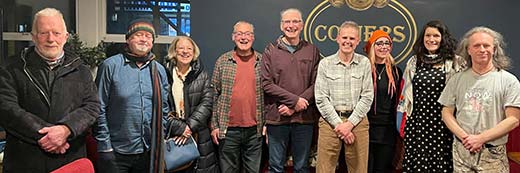
I'm full of admiration for the new, Shaggy Dog committee and their efforts to relaunch the famous club at the famous Dusty Miller in Mytholmroyd, following the temporary closure of Stubbing Wharf.
Here's a group photo of the tellers in last week's event. (Despite my attire, the room was plenty warm enough.) I wouldn't have missed the tale told by Lara the York based Celtic voiced, humorous and lyrical Lara, seen here wearing the fish hat. I'm glad to boast that I managed to rouse the audience to a hearty chorus of Grim Down South and raise a few chortles in response to Marjory Dexter, Schools Inspector both in Mytholmroyd and at Todmorden's Golden Lion, where the words from the poets and some of the musical numbers were thrillingly good.
(But can the Lion track down and devour the vandals who've stolen the toilet seats – porcelain is such an unforgiving material, especially in winter).
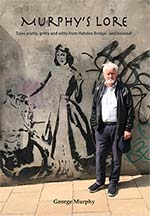
Murphy's Lore, the book, is available to order here
If you would like to send a message about this piece or suggest ideas, email George Murphy
More Murphy's Lore
See the Murphy's Lore home page for over 160 episodes.