

Saturday, 18 April 2026
The University of the Third Age meeting report
Mobile Police Museum
Speaker: David Hardcastle
The guest speaker at the u3a Todmorden members meeting in April 2026 was David Hardcastle, with his 'Mobile Police Museum'. Most, if not all of the exhibits, were already laid out on a long table and David said he would try his best, in the time allotted, to describe and speak about as many as he could.
David had already worked in the Bradford Police Museum and, during that time, suggested that a mobile museum would better serve the public by taking the exhibits to where they lived, rather than them travelling to Bradford. Before starting the actual presentation, he mentioned having another one in the evening, and that we would watch and listen to the eighth show this week.
During the talk, David passed the items he spoke about to the audience to examine, but advised against trying them out with their neighbour in the next seat. He mentioned, for example, that he did have keys for the numerous pairs of handcuffs passed round, but there could well be a delay in releasing any members who tried them out.
Handcuffs have throughout the history of policing, been the main, and simplest, means of controlling someone who has been arrested, or who is resisting arrest. Similar advice followed with regard to the several truncheons which circulated, David advising that these weapons were designed, and meant, to kill. As we know already, most of the police officers in Britain do not carry firearms unless specially trained.
Most, if not all, of the audience knew that Sir Robert Peel formed the Metropolitan London Police Force. This was in 1829 and since then we still might call them 'bobbies' even if we, perhaps, don't see them as often as we used to. The policing model spread around the country from then on. Sir Robert wasn't far from us in his former years, attending Heckmondwike Grammar School before his political career.
The term 'constable' actually goes back to the 16th to 17th century. Parish Constables were intended to serve the monarch – and the principles of our modern police force date back to those times. They are to preserve life, protect property and to keep the King's, or Queens peace.
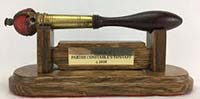 The constables would carry a Tipstaff, shown and passed round by David. It is a short staff, hollowed out in the middle to contain a warrant, or similar document. It would have a crown at one end, to represent and serve the Monarch. David described it as the same as the warrant card, held by every police officer in the country. If there was resistance to an arrest, or other trouble, the tipstaff had a protruding piece of metal at one end which could result in fractures for the miscreant. There were no actual uniforms at this time, so the tipstaff would confirm the authority of the constable.
These preceded the 'Watchmen', who first appeared in the larger cities in Britain such as York or London. These cities would have gates to enter them, which would be closed and locked after dark. The watchmen would be responsible for manning the gates, preventing contraband being brought in, and raising the alarm if a fire broke out. As time went on their duties changed, and many became guards at the Tower of London.
Some years later, the next version of policing in London – the 'Bow Street Runners', formed by Henry Fielding – and these officers still operated for ten years after Sir Robert Peel started the Metropolitan force.
David took us through a history of handcuffs, which included a model known, in the Metropolitan Police, as 'come-alongs'. The person arrested had one wrist fastened, and the constable took hold of the handcuff to lead them away. If this was resisted, the officer could twist the handcuff causing much discomfort to the prisoner and gain compliance. He also showed us a short lived invention of handcuffs, supplied to plain clothes officers. The arresting officer would need to use both of his hands to open and close the handcuffs, trusting the burglar or whoever not to run off while he, or she, was preparing them.
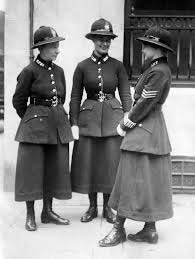 Police officers were almost exclusively male up until around the end of the First World War. More women became police officers from then on, presumably because of the casualties of the conflict.
The first uniforms issued to the women, which included long and heavy skirts and dresses, might not have been the best garments to carry out their duties. Policewomen would not be issued with trousers until the 1980s.
He showed us some women police officers hats from the 1960s in Australia. They would have been modelled from their original headwear in Britain which was issued after the Boer War, and painted black. He reminded us of the BBC series, 'Juliet Bravo', from the nineteen eighties. By this time, the hats would made of polycarbonate. He went on to show a number of hats worn by women officers, by wearing them himself - to much amusement from the audience. One of the hats was from a now disbanded police force - The Royal Ulster Constabulary (RUC) which changed to the Police Service of Northern Ireland (PSNI).
David's millinery collection included one obtained from ebay. This was, or is, a hat worn by an assistant Chief Constable of Police Scotland. David had his own theory of how the hat found its way to that supplier, but trusted our audience to keep it under their own hats.
He produced another rare early piece of equipment, a forerunner of the torch. This was a Victorian "bullseye" lantern, used by police from the 1820s for around 100 years. This was being passed round the audience, and David asked a member to read out some writing on the piece… "Bourneville Cocoa". An officer, formerly an engineer. had been issued this lamp and had repaired it at home. The lantern was still in use right up to the 1950s. David showed another artefact from a few years earlier, during the second world war – a gas mask. The item probably wouldn't have been much used at this time, but perhaps that was just as well - as the filter in it was made of asbestos.
Around the same time, in Todmorden, there were no sirens or suchlike to warn of air raids but David assured us that a rattle, similar to those used years ago at football matches, would be deployed. He demonstrated this rattle, secure in the knowledge that the audience were still awake.
Towards the end of the presentation David showed, and demonstrated some items still in use by the police today including Motorola radios – which nowadays have a feature that will identify where an officer is calling from – very useful if they are in trouble of some kind. He also had two Tasers in his collection, which when deployed by the police can deliver up to fifty thousand volts if and when required. For violent public order occasions, and if threatened, officers can deploy their 'Asp' to any attackers without having to get too close to them, which serves to prevent injuries and disperse crowds.
Our members may well be convinced that this travelling museum was much better, and more fun, than a trip to Bradford and back.
Not yet a member? We're always delighted to welcome new members. Contact details: website at www.u3atod.org.uk or email at info@u3atod.org.uk.
Many thanks to Colin Sanson for this report
Previous U3A reports on the HebWeb - click here