

Friday, 19 June 2026
The University of the Third Age meeting report
Passports, Assassins, Traitors and Spies
Speaker: Martin Lloyd
The guest speaker at the June 2026 meeting of U3A Todmorden was Martin Lloyd. He is an author, and former immigration officer with twenty four years service, and presented 'The Passport, the History of Man's Most Travelled Document'.
His presentation was in three parts, and the first concerned an incident in France which involved the then President Napoleon. Not the most famous Napoleon, who might have at one time said 'Not tonight Josephine', but his nephew, Napoleon III, who became the Emperor of France.
An attempt to murder the president was made at the Paris Opera House. This again wasn't the most famous one but another which, Martin told us, resembled a railway carriage. On 14th January 1858, Napoleon approached the venue with an entourage of other dignitaries and his personal protection guards in their carriages. Witnesses of what happened next would report seeing an object like a globe being thrown towards the procession. This, along with two others, resulted in killing eight people and injuring over a hundred more. Despite their carriage being damaged, the Emperor and his wife survived the assassination attempt with minor injuries.
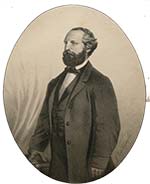 The incident became known as the 'Orsini Affair', the name of the would-be assassin, Felici Orsini. He was an Italian revolutionary figure and caused a major change in the issue and use of passports. Italy, at this time, was not unified. Various cities in that country were known as states in themselves, particularly the Papal States of these times. Each of these cities, and other areas, issued their own version of passports. In addition, France had established a garrison of soldiers in Rome.
Orsini, along with others of the same belief, wanted the whole of Italy to be one complete nation and ruled by its own people. His co-conspirators were diverse and played their own parts in the attempted murder of Napoleon. Orsini and his associates obtained passports to enter France before the assassination attempt on Napoleon, travelling under false identities and forged documents.
Contemporary accounts note that before the bombing attempt in Paris, one of Orsini's associates was recognised by the police and detained. He was questioned about what he was doing but refused to speak to the police until around 8.30pm, when he told them that they were too late. One of the officers remembered that Napoleon and his wife would be attending at the Paris Opera House, and would be arriving there at this time. An officer ran towards the theatre, getting there just as the first explosion had occurred. Some time later, another of the gang was arrested after being seen in a café with a gun in his pocket. The rest of the gang, including Orsini, were subsequently arrested.
There was outrage amongst the French Government, and people, about the gang members being able to enter their country with false documents – particularly those issued in England. Subsequently, visitors to France on things like day trips via boats were not allowed to enter the country. The attack created a diplomatic crisis between Britain and France because Orsini had planned parts of the plot while living in Britain. Prime Minister Lord Palmerston then introduced legislation to make conspiracy to murder a foreign ruler a felony, but his government was defeated in Parliament shortly afterward and he resigned in February 1858.
Part two of Martin's presentation concerned an American tourist Charles A. Inglis who applied for an emergency United States passport in August 1914, just after the outbreak of the First World War. At this time, Americans and other foreigners in Germany needed travel documents and exit permits to leave the country. This was possible because passports of this time were much less secure than we have today. Inglis's passport was essentially a single-sheet document and did not contain a photograph, fingerprints, or other reliable biometric identification.
But the passport disappeared while going through German official procedures, and was diverted secretly to naval intelligence by the German authorities.
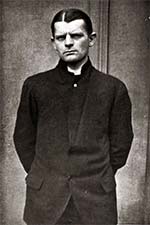 It was then given to Carl Hans Lody, a German spy for his espionage missions, subsequently making it relatively easy for Lody to travel under Inglis's name.
He journeyed via Denmark and Norway to Britain; posing as the American tourist "Charles A. Inglis." His fluent English and American accent helped support the disguise. Lody arrived in Britain shortly after the outbreak of war and was sent to observe Royal Naval activities, particularly around Scotland.
He had received little or no espionage training and made several mistakes, allowing British counterintelligence to identify and monitor him. He was eventually arrested, and subsequently executed, by firing squad at the Tower of London on 11th November 1914.
The case was a fascinating example of how easily travel could be before passports routinely carried photographs - a weakness that many governments moved to address during and after the First World War. From then on and eventually, every country in the world would issue passports with photographs of the holder.
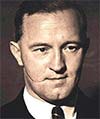 Finally, another story concerning Germany; this time in World War Two. "Lord Haw-Haw" was the nickname given by British journalists to radio broadcasters who transmitted Nazi propaganda from Germany to Britain. William Joyce was born in the United States to Irish parents and grew up in Ireland and Britain. He became involved in British fascist politics before the war. A few days after war broke out, he fled to Germany and began broadcasting from there. His distinctive voice and mocking style made him instantly recognisable to British listeners.
Millions of people in Britain tuned in to his broadcasts - not necessarily because they believed them, but because they were curious about what the Germans were saying. His programmes mixed news, propaganda, and attempts to undermine British morale during the war.
After Germany's defeat in 1945, Joyce was captured near the Danish German border. He was brought back to Britain and tried for treason. After a number of unsuccessful appeals, he was hanged on 4 January 1946. The legal basis for the conviction was unusual: although his nationality was disputed, he had held a British passport and was deemed to owe allegiance to the British Crown while using it. His wife Margaret was sent back to her prison camp in Germany after her being found not guilty of treason.
Following a round of well-deserved applause at the end of his presentation, Martin told us about the books he had written, and there was a healthy queue of our members at his table after our meeting closed.
One of the questions afterwards concerned the impact, perhaps, of people applying for a passport from Ireland after the result of Brexit some years ago. Martin said that the British system of issuing passports is the most complicated and convoluted in the world. For example, there are twenty-three different classes, or versions of being a British Subject. This resulted from the days of Britain ruling a fairly large proportion, for its size, of the world. The people from those countries, and some relatives, were entitled to have a passport to visit or even live in Britain – and 'dual nationality' is still recognised and catered for.
A well-earned vote of thanks, after well over an hour, ended this stimulating, humorous and informative presentation.
Not yet a member? We're always delighted to welcome new members. Contact details: website at www.u3atod.org.uk or email at info@u3atod.org.uk.
Many thanks to Colin Sanson for this report
Previous U3A reports on the HebWeb - click here